

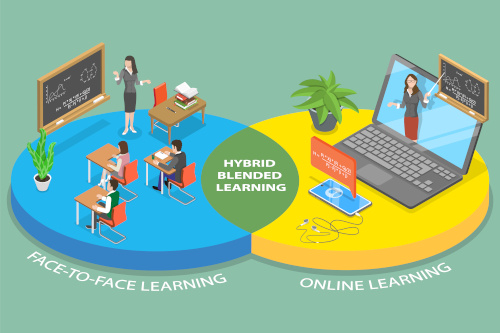
The last few years have seen the education sector undergo revolutionary change. Leading this revolution is hybrid learning — a model that marries traditional classroom instruction with online instruction technology. Initially adopted as a stopgap during the COVID-19 pandemic, hybrid learning has since become a progressive, responsive, and effective way of learning.
As students, educators, and institutions become more aware of this model, it’s clear that hybrid learning is not merely a Band-Aid solution — it’s where learning is headed. By combining the benefit of in-class and online learning, hybrid learning is changing the way knowledge is transferred, acquired, and applied.
Learning Anytime, Anywhere
By far, the most promoted benefit of hybrid learning is its freedom. Students no longer have to be tied into rigid class schedules or the confinement of the classroom. They can listen to recorded lectures, read texts, and do homework according to their own timing and location.
This level of flexibility is particularly convenient for students who have other obligations elsewhere, such as part-time employment, caring responsibilities, or after-school programs. It also allows them to learn at their own pace — studying difficult concepts as many times as they need — leading to better understanding and retention.
Improved Student Engagement
Another myth about online learning is that it leads to isolation or disinterest. However, most frequently, hybrid learning enhances levels of engagement when well-designed. Teachers can use computer technologies like interactive quizzes, discussion boards, polls, and games to maintain active participation on the part of learners.
These modalities are especially appealing to students who may be less engaged in a traditional classroom. Online environments can provide a less threatening space for quiet learners to ask questions, share opinions, and offer ideas. The two-way mode of participation ensures that more students have an avenue of accessing the content and others in a meaningful way.
Personalized and Adaptive Learning
Hybrid learning offers a more personalized learning experience. Students can choose to learn according to their preferred learning style — whether it is through video lectures, audio podcasts, reading, or visual aids like infographics and animations. Teachers are able to deliver different formats of content to suit different learning styles.
Along with this, online learning environments will often include analytics to allow teachers to track students’ unique progress. This allows instructors to make adjustments to instruction and feedback for a student’s specific needs and strengths. Struggling students can receive additional support, and high-performing students can be challenged with enhanced opportunities.
Increasing Digital and Life Competencies
As students use an assortment of technology tools in a blended setting, they naturally become more comfortable with technology — a fact in today’s world. They learn to collaborate using learning management systems, communicate properly on the Internet, meet their deadlines without supervision, and learn at their own pace.
These are not just academic achievements; they are **career-ready skills** that prepare readiness students for college, career, and a lifetime of learning. Time management, flexibility, self-discipline, and digital literacy are all encouraged through blended learning environments.
Deepening the Teacher-Student Relationship
Hybrid learning does not destroy the dynamic between teachers and students — it can actually deepen it. With fewer hours spent on lecturing, teachers gain more time to spend on one-on-one interactions, mentoring, and constructive feedback.
Online forums and online chat also facilitate more regular interaction outside the class schedule. Learners may start with questions at any time, and instructors may respond when they are able, without being confined by the limitations of a short class session. The ongoing discussion provides cooperation and a generally stronger support group for students.
Making Education More Inclusive and Accessible
Most importantly, by far, the most revolutionary change caused by hybrid learning is the democratization of education. Rural students, students with physical or learning disabilities, or students who cannot attend the conventional classes due to health or economic reasons now have better access to good quality education.
They can tune in to a lecture by the best educators, receive online certifications, and connect with fellow students worldwide — opportunities not before possible. Hybrid learning bridges gaps by making education accessible to all, everywhere.
Preparing Teachers for New Technology
The educators have also benefited significantly from the hybrid model. They are now able to utilize an abundance of tools that facilitate more creative and effective teaching. From shared documents and digital whiteboards to multimedia presentations and web-based simulations — teachers are now able to present lessons more forcefully and connect them to contemporary life.
The opportunities for teacher professional development have also increased, with more online modules for training, webinars, and forums where they can share best practices and learn new ones.
A Look Ahead: The Future Is Hybrid
Looking ahead, it is evident that hybrid learning is not a momentary anomaly but a revolutionary shift in the way education is done. It is an answer to the new needs of students and to the capabilities of technology. By retaining the crucial value of traditional education — discipline, direction, peer interaction — combined with the innovations of new media, hybrid learning has the best of both worlds.
It fosters continuous improvement, enables teachers and learners alike, and prepares learners to meet the challenges of a rapidly changing world.
Hybrid learning is redefining education in practical, inclusive, and forward-thinking terms. It provides flexibility without compromising quality, accessibility without compromising standards, and personalization without compromising structure. As this strategy is pursued by more, education will not only be more effective but also more engaging, allowing students to take ownership of learning and the future.
The future of education today — and it’s hybrid.
