


Abhishek Verma was born on 23 February 1968 in New Delhi, India. He hails from a politically active family. His father was Shrikant Verma, a noted journalist and a member of parliament. His mother, Veena Verma, served multiple terms as Member of Parliament and was Vice President of the women’s wing of a major national party.
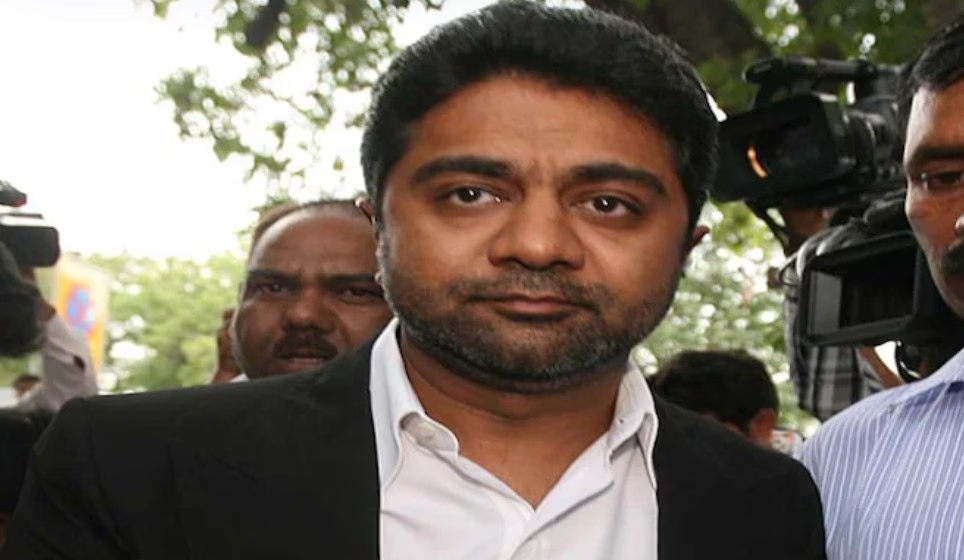
Growing up in that environment, Verma was well aware of politics, power corridors, and public life. However, those early connections and upbringing arguably formed the base on which he later built his business and political ambitions.
Business Career and Diversified Ventures
Though best known as an arms dealer, he claimed involvement in a variety of sectors over the years.
In the 1990s and early 2000s, he positioned himself as a global arms broker – allegedly facilitating large defence contracts between foreign suppliers and India.
Verma reportedly attempted to diversify after facing intense scrutiny and controversy, especially in the arms business.
For instance, in 2004, he struck a deal with the government-run telecom provider to run a “netTV“ service through his company although that venture did not match the scale or impact of his defence dealings.
By 2016, he publicly declared he was stepping away from arms trading.Besides, he told media under the aegis of a national “Make in India” initiative, he would pivot to sectors like coal and food distribution.
Despite these assertions, many former associates and critics argue the outward show of wealth, i.e. lavish parties, high-end lifestyle masked underlying financial difficulties.
According to one profile, after getting release from jail in 2008, Verma “lived on borrowed opulence,“ borrowing even small amounts from friends, with many business deals failing before taking off.
Allegations, Controversies and Legal Battles
His name has long been associated with major defence-deal scandals. Chief among them is the Scorpene submarine deal scandal – a case involving procurement of submarines, in which Verma was one of the prime suspects.
In 2006, opposition parties accused him of receiving kickbacks of up to US $200 million in the deal, alleging his political connections which helped secure the contract. Verma and the involved companies denied the allegations, and even filed defamation suits.
Further, in 2012 the Central Bureau of Investigation (CBI) raided his multiple premises in connection with corruption and money-laundering cases.
Another controversial episode involved an alleged forgery. In 2009, he was accused of writing a letter on a forged letterhead of then – Home Minister (state) to influence visa-related norms. That case too lingered, drawing media attention and raising questions about misuse of political connections.
Over the years, multiple allegations, including secret bank accounts in Liechtenstein, hidden assets, money-laundering and leaking of classified defence documents have hovered around him.
Yet, the Indian judiciary and investigators have often failed to find conclusive evidence. For example, in April 2017 a special CBI court discharged Verma and his spouse in one bribery and money-laundering case involving the Swiss firm, citing lack of evidence for prosecution.
Furthermore, in a forgery case filed by CBI, a Delhi court acquitted him holding that the prosecution had not proved its case beyond reasonable doubt.
Verma had also been given “Z-category” protection by Delhi Police because of his controversial past and security threats, particularly after becoming a witness in a high-profile communal riots case.
Nonetheless, critics and journalists often describe him as a flamboyant showman who adapt at projecting wealth and power even when actual substance was lacking.
Political Entry and Recent Developments
Although from a politically active family, Verma had initially stayed away from active politics. He was once approached by a national party for a parliamentary run (from the lower house) in 1996, but he declined, citing personal reasons.
It changed in early 2025, when he formally joined Shiv Sena (under the leadership of Eknath Shinde). The party appointed him as its Chief National Coordinator for elections and alliances.
The move surprised many in political circles given his checkered past and controversial history, but it appears the party aims to leverage his perceived connections and organisational skills to expand its footprint beyond its traditional strongholds.
While aligning himself politically with a right-wing party, he also claims to be transitioning his business portfolio towards sectors like coal, food, and possibly other consumer goods, distancing himself from defence-related trades.
Public Image : Between Notoriety and Reinvention
Over nearly three decades, Abhishek Verma has morphed from a “young billionaire arms-dealer” into a controversial public figure often vilified and scrutinised, yet never definitively convicted in many of the high-profile cases against him.
Because of the nature of his business, he was targeted. For instance ; international defence deals which attract intense political rivalry and media glare. According to some critics, he exploited political patronage, manipulated legal ambiguities, and used influence to project wealth and power without solid business foundations.
In recent years, with his entry into active politics and the purported shift towards legitimate business sectors, Verma appears intent on rebranding himself perhaps hoping to cast aside the “arms-dealer” label and emerge as a mainstream businessman-politician.
Legacy So Far – A Complex and Contested Figure
Abhishek Verma’s life and career embody many contradictions. On one hand, he rose from a privileged political family to allegedly broker multi-billion-dollar defence deals. On the other hand, many of those deals ended in scandals, investigations, and court cases.
While he projected wealth, luxury and high social status on the one side. But, on the other side, associates and critics claim much of it was superficial, i.e. borrowed money, ghost companies, unfulfilled deals.
Despite repeated allegations of corruption, money-laundering and forgery, Indian courts and investigative agencies have either acquitted him or failed to mount conclusive prosecution for many of the cases.
For some, it underscores weaknesses in evidence or prosecution. On the contrary, for others, it suggests influence and power played a role.
Now, as of 2025, with a political role in a national party, and claims of diversifying business interests, Verma may be attempting a transformation from a tainted “arms-dealer” to a businessman-politician with mainstream aspirations.
The story of Abhishek Verma remains one of ambition, influence, controversy, reinvention, and the complex interplay of power, money, politics and public scrutiny in India.
