


Why Aravalli Hills Matter: Understanding the Ongoing Controversy
Aravalli Hills controversy has intensified after the Supreme Court approved a new definition of the ancient mountain range, triggering concerns over mining, environment, and climate balance in North India.
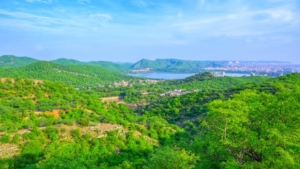
Stretching nearly 650 kilometres from Delhi to Gujarat, the Aravalli Hills play a critical role in North India’s ecological balance.
What Is the New Definition?
On November 20, the Supreme Court approved a proposal that redefines what qualifies as part of the Aravalli Range. Under the new framework, only landforms rising at least 100 metres above surrounding terrain will be classified as Aravalli Hills. In addition, clusters of two or more hills located within 500 metres of each other will also fall under the definition.
The Centre framed this definition based on recommendations from a government-appointed committee. Officials argue that the change brings clarity and uniformity to land classification.
Why Environmentalists Are Concerned
Environmental groups fear that the new criteria could exclude a large number of smaller hills from protection. Many Aravalli formations are low-lying but ecologically significant. If removed from the protected category, these areas could become vulnerable to mining, real estate development, and industrial activity.
As a result, activists across the country have launched the #SaveAravalli campaign, warning of long-term environmental damage.
Although the Union Environment Ministry has directed states to halt new mining leases in the Aravallis, critics say the order does not fully address loopholes created by the redefinition.
How the Aravallis Protect North India
Geologist Professor S.P. Sati explains that the Aravalli Range acts as a natural barrier against desert expansion. The hills restrict the eastward movement of dust and sand from the Thar Desert. They also help regulate temperature and wind patterns across northern states.
If the Aravallis weaken, hot desert winds could travel freely, worsening air pollution and increasing levels of harmful particles like PM2.5. This could intensify health risks in densely populated regions.
Impact on the Himalayan Ecosystem
According to experts, dust from degraded Aravalli regions can travel toward the Himalayas. When dust settles on glaciers, it absorbs more sunlight and accelerates melting. This process could worsen the already fragile condition of Himalayan glaciers affected by climate change.
While the Aravallis do not directly influence monsoon rainfall in Uttarakhand, scientists warn that broader climate disruptions could follow.
Why the Debate Matters
Experts agree that protecting the Aravalli Range is not just a regional issue. Its degradation could affect climate stability, air quality, and water systems across North India. Many now call for a reassessment of the new definition and stronger safeguards to preserve this ancient mountain range for future generations. Follow for more updates on FM News.
