

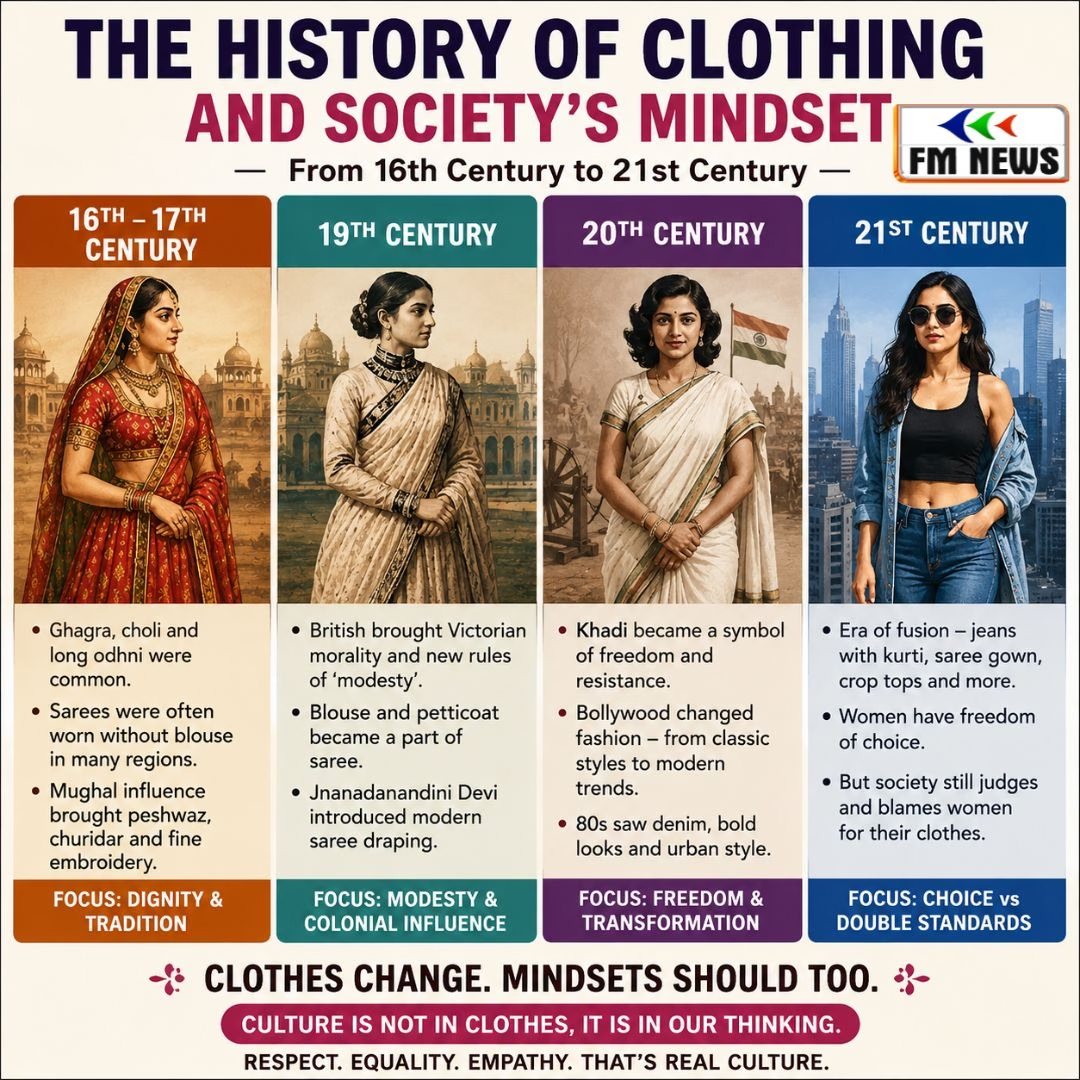
In the 21st century, we are talking about building homes on the Moon, and bringing revolutionary changes in AI and technology. Yet, one thing still seems stuck in the past-the “gaze.”
Whenever an unpleasant incident occurs in society, the first fingers are often pointed at women’s clothing. Comments like “Why did she go out wearing such short clothes?” or “She was asking for it” are not limited to the uneducated. They are often heard even from educated youth and elders at home.
But have you ever wondered what the so-called “Indian culture,” used today to judge clothing, actually looked like in history? Do you know what women wore in the 16th century? In this video, we will explore history and understand how clothing and social mindset have evolved from the 16th century to the 21st century.
16th and 17th Century – Simplicity and Grandeur
Let’s begin with the 16th century.
At that time, clothing in India was determined by region and social status. There were no modern “brands”-clothes were primarily meant for protection and dignity.
Ghagra and Choli:
Women in Rajput and North Indian regions wore heavily flared ghagras with cholis, along with a long odhni or panchatoliya used to cover the head and upper body.
The Truth of the Saree:
Surprisingly, in many regions, sarees were worn without a blouse (choli). Fabrics were usually muslin, silk, or cotton.
Mughal Influence:
With the arrival of the Mughals, garments like the peshwaz (a gown-like outfit) and churidar pajamas became popular. Fine embroidery such as zari and zardozi became a symbol of elite status.
Interestingly, even though clothing in that era was, by modern standards, sometimes less covering, women were still depicted with dignity in historical art and culture.
19th Century – British Influence and the New Definition of ‘Modesty’
The 19th century brought a major turning point in Indian clothing history.
With British colonial rule came Victorian morality. For the British, traditional Indian sarees-often worn without blouses-were considered “immodest.”
Birth of the Blouse and Petticoat:
The blouse and petticoat, now seen as essential parts of the saree, were largely influenced by British colonial standards. Covering the body became associated with “decency.”
Contribution of Jnanadanandini Devi:
Jnanadanandini Devi, the sister-in-law of Rabindranath Tagore, developed a modern saree draping style by blending Indian and Western influences. This allowed Indian women to adapt sarees into a more “formal” look suitable for British social settings.
Ironically, many elements that are now called “pure Indian culture” were significantly shaped during the colonial period.
20th Century – Independence, Khadi, and Bollywood
The 20th century brought both struggle and transformation.
Khadi and Freedom Movement:
Mahatma Gandhi turned khadi into a symbol of resistance. It became more than fabric—it became a political statement. The silk of royals was replaced by the simple khadi saree of the common woman.
Bollywood Era:
In the 1960s and 70s, cinema reshaped fashion trends-tight kurtas, the iconic Sadhana haircut, and winged eyeliner became popular. In the 1980s, denim and leather jackets entered urban women’s wardrobes.
21st Century – Fashion vs Double Standards
Today, we live in an era of fusion fashion-jeans with kurtis, saree gowns, crop tops, and much more. Women are free to choose what they wear.
But has society evolved at the same pace?
History shows us that clothing has always changed. There was a time when sarees without blouses were normal, and even covering the head with a veil (ghunghat) was expected.
Yet today, when a girl dresses according to her choice, her clothing is sometimes blamed for crimes. Some people even argue that certain clothes lead to sexual violence.
But do they realize that women in the 16th century often wore outfits that were, by modern standards, even more revealing than today? Yet society then did not hold the same mindset.
Clothing is meant to protect the body-not to justify someone’s wrongdoing.
If clothes were truly the cause, then crimes would never happen against toddlers or women wearing full covering like burqas. Clearly, the issue is not clothing-it is mindset.
Conclusion
History proves that clothing has constantly evolved, but human thinking has not always progressed at the same pace.
The real question is not what someone is wearing, but how we look at them.
Culture is not defined by clothing-it is defined by respect, values, and human mindset.
What do you think? Can society change this way of thinking?
